






Access via any AI (MCP)
Your AI is brilliant.
But it misses the whole picture.
What’s our refund policy?
Customers can request a refund within 14 days.
- Outdated context
 last edited 8 months ago
- No single source of truth contradicts

- MCPs: slow, expensive, partial Assembling context
Introducing Suda
The company brain for your team and enterprise. One permissioned context graph your people and your AI agents can read.
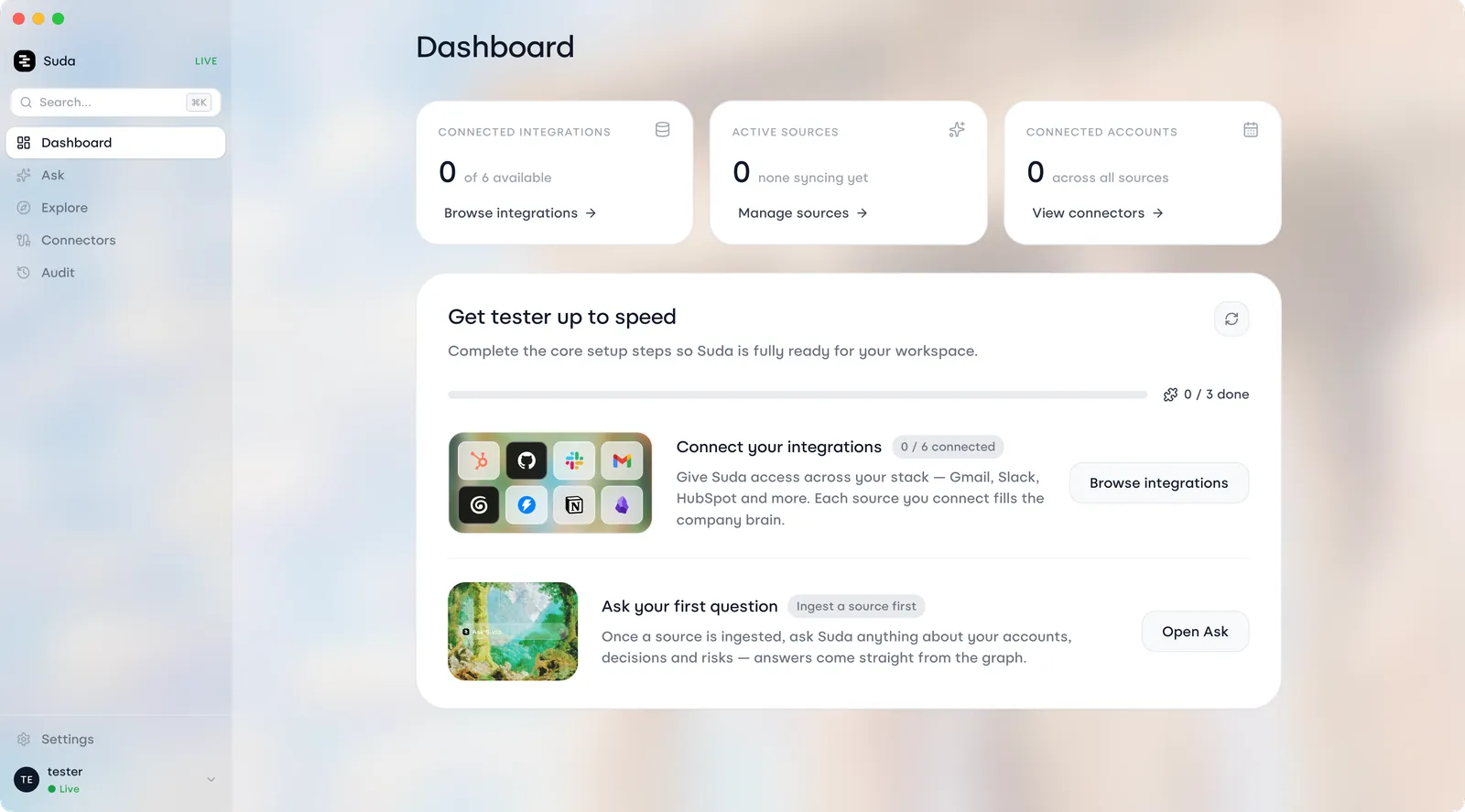
A continuously updated context graph
for your company brain
and your personal brain.
Self-updating context
Notion docs access
restricted
Slack #support access
restricted
 GitHub repo access
restricted
GitHub repo access
restricted
 Billing inbox access
restricted
Billing inbox access
restricted
Control who can access what
Encrypted
Ask context in Slack




















































Ingest from +700 sources
Live in three steps.
Then forget it's there.
- 01
Connect your tools
- 02
It builds itself
- 03
Plug in your agent
Any AI that speaks MCP can use it.
$ npx suda connect --agent claude
Structured context beats raw retrieval.
what's our refund window?
30 days since the March policy update.
policy-v3 #support  LIN-482
 Stunning context quality
Answers from how your work connects, not the closest-matching paragraph.
Uses fewer tokens
Only the context that’s needed reaches the model. Less noise, lower cost.
refund_window live
30 days
current
14 days
retired · superseded by 3 sources
Always current
Stale facts retire and conflicts resolve on their own. No cleanup.
Start free.
No credit card required.
Pay as you go.
Free
$0 free forever
For trying Suda on your own stack.
- 1,000 credits included
- 1 to 5 seats
- All 700+ integrations
- Personal context graph
- MCP access for any AI agent
- Cloud deployment
- Community support on Slack
Business Most popular
$20 per user, per month
For teams that run on shared context.
Top up $10 per 10,000 credits.
- 12,000 credits per month
- Up to 50 seats
- Everything in Free
- Shared company context graph
- Full permissioning & access controls
- Priority sync across your sources
- Cloud hosted
Enterprise
Custom annual billing
Security, scale and support for larger teams.
- SSO, SAML & SCIM provisioning
- Audit logs & advanced controls
- Self-host your context graph
- 99.9% uptime SLA
- Dedicated support & onboarding
1,000 free credits
Yours the moment you sign up.
Questions, answered.
-
What is Suda?
Suda is context infrastructure for AI. It turns what is scattered across your tools, like Notion, Slack, and Linear, into a living context graph that any AI agent can read. Instead of each tool holding a piece of the truth, Suda keeps one connected, permissioned source your AI can use.
-
Is Suda a company brain?
Yes. Suda is the company brain for your team and enterprise. It connects your tools into one permissioned context graph, so your whole company knowledge lives in a single place your people and your AI agents can query. Suda also runs as a personal brain for each person and an AI brain for your agents, all from the same graph.
-
Is Suda AI the same as Suda.so?
Yes. Suda AI, Suda Company Brain, and Suda.so all refer to the same product: Suda, the company brain at suda.so. There is one Suda, reachable at suda.so.
-
How is a context graph different from RAG or a vector database?
RAG retrieves the paragraph that looks most similar to a question. A context graph answers from how your work actually connects: who owns what, what supersedes what, which decision is current. Because it sends only the context that is needed, Suda passes about 85% less text to the model, so answers cost fewer tokens and carry less noise.
-
Which tools does Suda connect to?
Suda ingests from more than 700 sources, including Notion, Slack, and Linear. New sources connect without custom pipelines, and the graph stays up to date as those tools change.
-
How does an AI agent access Suda?
Any AI can reach Suda over MCP (the Model Context Protocol), so agents in your existing stack query the context graph directly. You can also ask context straight from Slack.
-
Does the context stay up to date on its own?
Yes. Suda is self-updating: stale facts retire and conflicting facts resolve automatically, so you do not clean up context by hand. What the model reads reflects the current state of your work.
-
Who can see what in Suda?
Suda is permissioned. You control who and which agents can access each part of the context graph, so sensitive context is never exposed to the wrong person or model.
-
How do I get started with Suda?
Run npx suda connect and link your first source. Setup takes three steps and a few minutes. Suda is free to start with no credit card, then pay-as-you-go for what you use.